
This is something I accidentally stumbled upon during a conversation being had about our rookie hitters, specifically Henry Davis and Endy Rodriguez. I have already dedicated 2000 words to Henry Davis and part of the problem I saw was his inability to hit sliders in any real capacity. Then I looked into Endy’s baseball savant page and noticed an almost identical problem. My curiosity had gotten the better of me and I then pulled up every single notable rookie hitter the Pirates debuted in 2023 and came to 2 conclusions: The Pirates’ development system is not preparing their hitters well to face MLB-level breaking balls, and I apparently can never stop writing about sliders. Regardless of the rookie hitter mentioned, they all got eaten alive by sliders specifically. Let’s quickly break down the numbers I’m talking about and then try to rationalize how every single hitter coming up through the system gets torched the second a pitcher pulls out their slider.
Here is a quick list of Pirates rookies who got substantial playing time last season and how they fared against major league sliders. Henry Davis hit .104 BA, and .208 SLG with a 45% whiff rate and 42% strikeout rate resulting in a whopping -8 run value on sliders. Endy Rodriguez hit .136 BA, and .273 SLG 32.7% whiff rate and a 45.5% K rate for a run value of -3. Liover Peguero hit .093 BA, and .233 SLG 50% whiff rate and a 54% K rate for a run value of -2. Nick Gonzales hit .091 BA, and .091 SLG 44.3% whiff rate 32% strikeout rate for a run value of -4. Jared Triolo hit .125 BA, and .150 SLG with a 48.1% whiff rate and a 48.9% K rate for a run value of -4. Alika Williams hit .214 BA, and .286 SLG with a 33.3% whiff rate and a 40% strikeout rate for a run value of -1. Ji-Hwan Bae was the only rookie with significant playing time who didn’t seem to completely lose the plot when facing sliders, hitting .244 BA, .366 SLG, and a 28.3% K rate for a positive run value of 1.
I did just throw a bunch of numbers at you and it was a lot, but just a cursory glance at how the Pirates youth dealt with sliders shows an organizational trend. The league average strikeout rate on sliders currently sits around 28%, so the only player that is league average is Bae and Gonzales is the only one who comes relatively close to being average when making contact vs the slider. When we are seeing prospects like Henry Davis who used to be able to kill sliders and was highly touted for his bat look like Jake Meyers, there is a cause for concern. I am comfortable believing that these numbers will improve as these players get more acclimated to major league play, but when every single prospect who comes up seems to struggle with the same issues when hitting it suggests to me that whatever the Pirates are doing in the minors with their hitters has not been working.
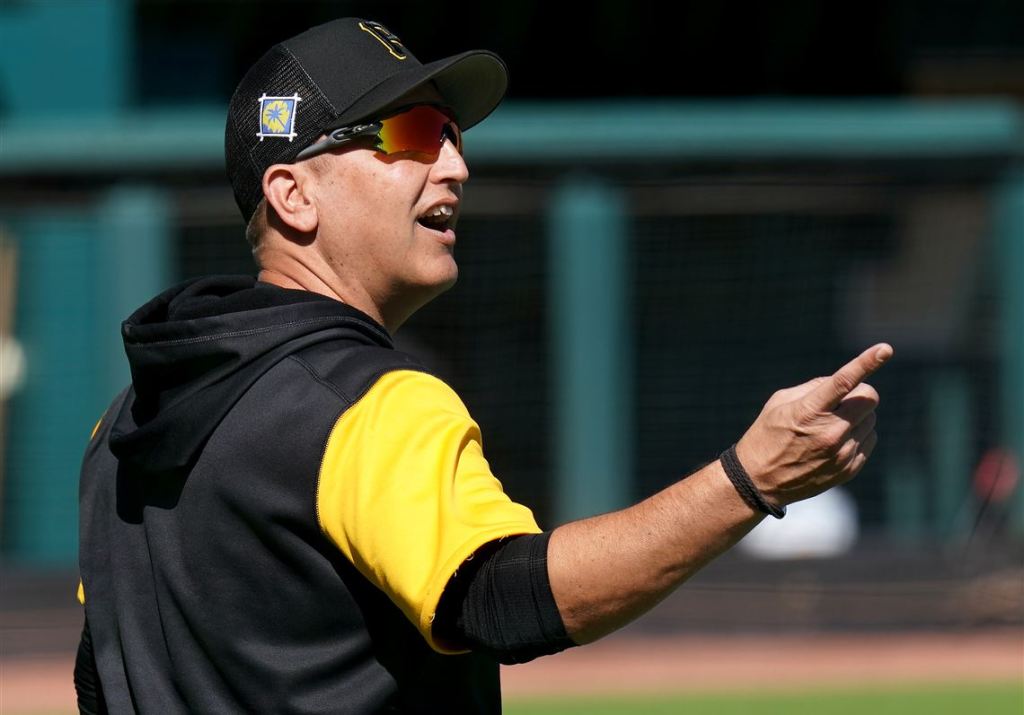
From an outsider’s perspective, it’s basically impossible to assign blame for a problem like this because none of us are in the building where these development strategies are made and implemented. The easy face to get mad at is Pirates’ hitting coach Any Haines. However, like how I feel that Derek Shelton is a face to shield bad decisions made by the front office, Andy Haines is the guy we see in the dugout every game and so he gets the brunt of the abuse. I am no fan of Haines and have never really been happy with the hire from the start, but there’s something very big to keep in mind. Haines was hired to fit an organizational philosophy that was established by his bosses. Andy is fully on board with the process but he is not the one who came in and implemented the patient approach that enraged many fans the past 2 seasons. I do however think that the patient approach we see implemented in guys like Termarr Johnson (the man never swings the bat) and by extension the rest of the minors do help create this issue of not hitting breaking pitches. Minor League pitchers are not good enough in terms of location to be able to place their breaking balls in the zone on a consistent basis. Most minor league pitchers who will never even sniff the majors have to rely on their fastballs in order to consistently throw strikes. The ones who can are few and far between and they are the ones who are usually on the fast track to the majors. So when you have this approach of waiting for your pitch to hit this allows the minor league hitter to be able to get away with sitting on fastballs because they know they can be thrown for strikes. This may result in putting up well-respected numbers that look pretty on a Fangraphs page, but in terms of being ready to face MLB-level pitching this leaves the batter woefully unprepared. MLB pitchers are on a whole different planet in terms of talent, because not only can they locate all their breaking pitches but they also know exactly which pitches are going to kill you as a hitter. Sure, the AA Bowie Bay Sox may know that Matt Frazier can’t hit certain pitches, but the majority of guys on that team wouldn’t be able to locate them consistently. The Chicago Cubs rotation is full of guys who can and will exploit hitter weaknesses and I do not believe that the way hitters are prepared in our development system makes them ready for the majors. I do have to stress that this is merely an opinion and that the overall lack of Statcast data we are able to pull from MiLB games might prove me wrong. However they are teaching guys to deal with breaking pitches, I think it’s fair to say it simply is not working.
A common reply that people usually say when you mention rookies playing badly is that it should be expected and that players need time to adjust to the league. This is true, I don’t mean to use this problem I see to say that none of these guys will become successful MLB players and some truly need more time to adjust. But there are 2 issues with this line of thinking that I mean to highlight. The first is that the excuse that rookies are going to struggle is somewhat falling by the wayside as MLB development keeps getting better. Diamondbacks superstar Corbin Carroll set the world on fire as a rookie, being the lynchpin to the offense that won the National League and finished in the top 5 of MVP voting. Yankees rookie shortstop Anthony Volpe finished his rookie campaign and won the gold glove along with a 3.3 WAR season. Both the Orioles and Reds have seen their rookies come up and immediately become stars. Seeing players like Gunnar Henderson, Matt McLain, Adley Rutschman, Spencer Steer, Andrew Abbot, and Kyle Bradish all dominate in 2023 makes you wonder what they are doing right and what the Pirates are failing to do. These are organizations like the Pirates who also do not spend any money because of stingy ownership, so they, like the Pirates, will have to rely on this pipeline of prospective talent to keep them successful. If Ben Cherington is going to build a winner in his time in Pittsburgh, it’s because he has cultivated a development system that churns out talent that he can pay MLB minimum for 3 years and fill in small holes through free agency. Right now, on a pitching and hitting side, we have not seen any fruits of this labor except for a 50-game stretch from Jared Triolo that simply cannot be replicated over a full season.

For once I’m going to end on a positive note because moves since the end of the 2023 season suggest to me that the Pirates know that what they’ve been doing simply hasn’t been working. They kept around Andy Haines, sure, but regardless of what I think of him, I don’t think he’s the main culprit in this organizational problem. They fired Altoona Curve hitting Coach Jon Nunnally immediately after the season ended, presumably for the Ke’Bryan Hayes debacle, and that Altoona hitters were not progressing under his watch. Regardless of what you believe about the Jason Mackey report about Hayes meeting with Nunnally for hitting help, he simply has not been good enough at helping our prospects develop at the plate. The more encouraging thing to me, however, is the hiring of Sarah Gelles as assistant general manager earlier last week. I mentioned teams like the Orioles as a team the Pirates had to replicate and Gelles has major experience in the former dynasty Astros and the 2023 AL East Champions Baltimore Orioles. Both these teams bottomed out for 5 years before their prospect cores came up and became 100-win ball clubs. The Pirates brass will never come out and say out loud that they messed up in the past, but changing personnel in the building and getting talented people in the door who have succeeded elsewhere is a good start. Hopefully, these changes spark the beginnings of the successful development of our players in Pittsburgh, starting with getting our hitters to hit Major League sliders.

 North Shore Nine
Leave a comment